If MLB owners want to lock out players, we know who we’re rooting for
As baseball’s collective bargaining agreement expires, we’re in for a rancorous offseason battle between labor and management.
Claire Hirschberg and Jesse Bernstein are Phillies fans and labor lawyers at the law firm of Willig, Williams & Davidson.
On Tuesday, the current collective bargaining agreement between Major League Baseball and the Major League Baseball Players Association will expire without a successor in place.
And if the reporting on mounting tensions over revenue sharing, competitive balance, and a salary cap is to be believed, this offseason will bring together two of America’s greatest pastimes: baseball and a rancorous battle between labor and management.
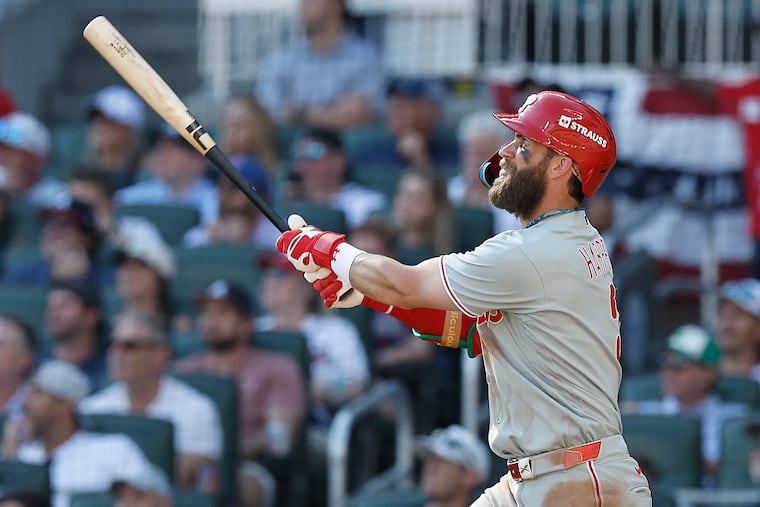
It could get ugly. Bryce Harper memorably invited MLB Commissioner Rob Manfred to vacate the clubhouse when Manfred dropped by in July 2025 to stump for the salary cap. Though the owners have not stated their intentions as colorfully, that shouldn’t be mistaken for timidity: They appear to be prepared for MLB’s first game-costing work stoppage since 1994.
In its public campaign, the league has sought to reduce this conflict to a series of seemingly logical propositions.
Baseball, according to the owners, is more fun for more fans when more teams have a realistic chance at competing for a World Series appearance — but the ability of one set of teams to outspend the others makes that outcome unlikely, as the highest spenders simply outresource the competition. Therefore, the league says, we need to “level the playing field” by capping the amount of money any team may spend on player salaries. Fans from Cincinnati to Colorado will no longer watch as the players they’ve developed flock to Los Angeles, New York, or San Diego. With everyone’s ability to spend on player salaries brought within the same, well, ballpark, playoff hopes will spring as eternally in Las Vegas as they do in Philadelphia (a fantasy if there ever was one).
As labor lawyers and sickeningly dedicated fans of the Fightins’, we say the same to you as we say to Trea Turner: Lay off that garbage. Baseball does not need a salary cap.
Team owners are relying on a series of shaky premises to characterize a straightforward attempt to reduce labor’s bargaining power into a fight about what’s allegedly best for fans. They would like for the public to feel a sense of sympathy for fans of the Marlins, and a concurrent resentment for those who root for the Dodgers.
What the owners do not want the public to consider is why the billionaire owners of teams like the Marlins don’t simply spend more money if they’d like to be more competitive. As MV3 put it so well: Only losers complain about the Dodgers.
Baseball does not need a salary cap.
Take a look at the Pirates. Pittsburgh’s payroll sat at $86 million in 2025 while the team finished dead last in their division and in runs scored. Meanwhile, the Pirates are one of the most profitable teams in baseball, per USA Today’s Bob Nightengale, happily pocketing revenue generated by other teams rather than investing in the success of one of baseball’s storied franchises.
Whose greed, exactly, is preventing the Edenic parity promised by the league?
The owners have offered some concessions: raising the minimum salary, eliminating deferred contracts, and allowing players 30 and older to reach free agency after five years, rather than six. And the owners have implicitly acknowledged the problem of owners’ unwillingness to spend by including a salary floor, in addition to the cap.
But look a little closer.
Those concessions could mean something for the league’s lower-end earners, and act as an accelerant toward top-flight pay for workers with short careers. But they also have an obvious divisive bargaining logic, distributing gains among particular groups of players in exchange for the union accepting a structural limit on the earning power of the bargaining unit as a whole.
The owners can afford to be generous in their other proposals because the cap is the real long-term concession from the players: If the union accepts this hard ceiling on overall salaries, it will be nearly impossible to undo, and the union will have to expend its bargaining power every contract cycle to keep raising the cap.
If MLB is so concerned about creating parity between teams, why should it stop with a cap on salaries? Why not make sure no team can significantly outspend the others on, say, scouting, training, and rehab facilities, analytics, or coaching staff, just like it already does with the international amateur bonus signing pool? Aren’t those elements, cumulatively, at least as important to sustained success as the ability to sign the highest-priced free agents?
MLB has the chutzpah to say its proposals will serve the fans and the players.
Since high salaries alone don’t guarantee team success, wouldn’t any serious effort to foster competitive balance take those elements into account, too? But the league does not appear interested in them.
MLB has the chutzpah to say its proposals will serve the fans and the players. But when the only field in need of leveling is the one that would reduce the power of labor, it is hard not to view the league’s avowed interest in fairness as something a little more self-serving. Instead, proud free-marketeers like the Cubs-owning Ricketts family want assurances that labor will willingly blunt one of its sharpest instruments: its ability to sell itself at the highest price the market will pay.
As MLBPA interim executive director Bruce Meyer has noted, the owners’ system of “institutionalized collusion” would have reduced player compensation by $500 million in 2026, had it been in effect (Manfred has disputed this).
And take a closer look at the revenue-sharing proposal. Under its proposal, the league would deduct up to 17% of local revenue and up to 22% of national revenue as “expenses” before the 50-50 split with the players, while also imposing unlimited deductions for stadium construction and “new ventures.” Meyer’s characterization was blunt: “MLB hasn’t proposed a 50-50 ‘split’ of revenues. Any suggestion otherwise is misleading propaganda.”
We are not so deluded as to think that the only thing keeping the Royals from becoming playoff fixtures is the will to win.
Nor do we propose that the remarkable sustained success of low-spending Milwaukee and Tampa Bay undercuts the indisputable premise that spending more money is correlated with more frequent playoff appearances.
And we also recognize the (recent) privilege of rooting for a big-market team willing to “be a little stupid” with free agents.
But there is scant evidence that a cap on salaries will solve the problem of haves and have-nots, let alone that it will spur low-spending owners to invest in their teams. Even the league, in quiet moments, admits that its proposals hardly guarantee better playoff outcomes for historical low-spenders.
Manfred’s recent comments make it hard to imagine pitchers and catchers will be reporting to training camp in February. For those of us who go full Giamatti over each new season, the prospect of a spring without baseball is disheartening.
But there’s no baseball without the players, who endure grueling scheduling and risk ruinous injuries for our entertainment every day.
Former Phillies backup catcher (and starting union rep) Garrett Stubbs put it succinctly: “We’re working hard off the field so that we can be the best on the field.” While we might not be reaching for striped overalls anytime soon, we’re listening to the pros when it comes to what is best for baseball.
Philadelphia is still a union town. If owners want to lock out players next season, we know who to root for.
About guest essays
Guest essays, or op-eds, are commentary pieces that present the opinion or perspective of the author. Many are submitted to us by Inquirer readers and writers with insight on the news, but we also solicit op-eds from authors on specific topics. For more information visit our guidelines.